How to Protect Your Business from AI and Deepfakes
- 30.01.2026

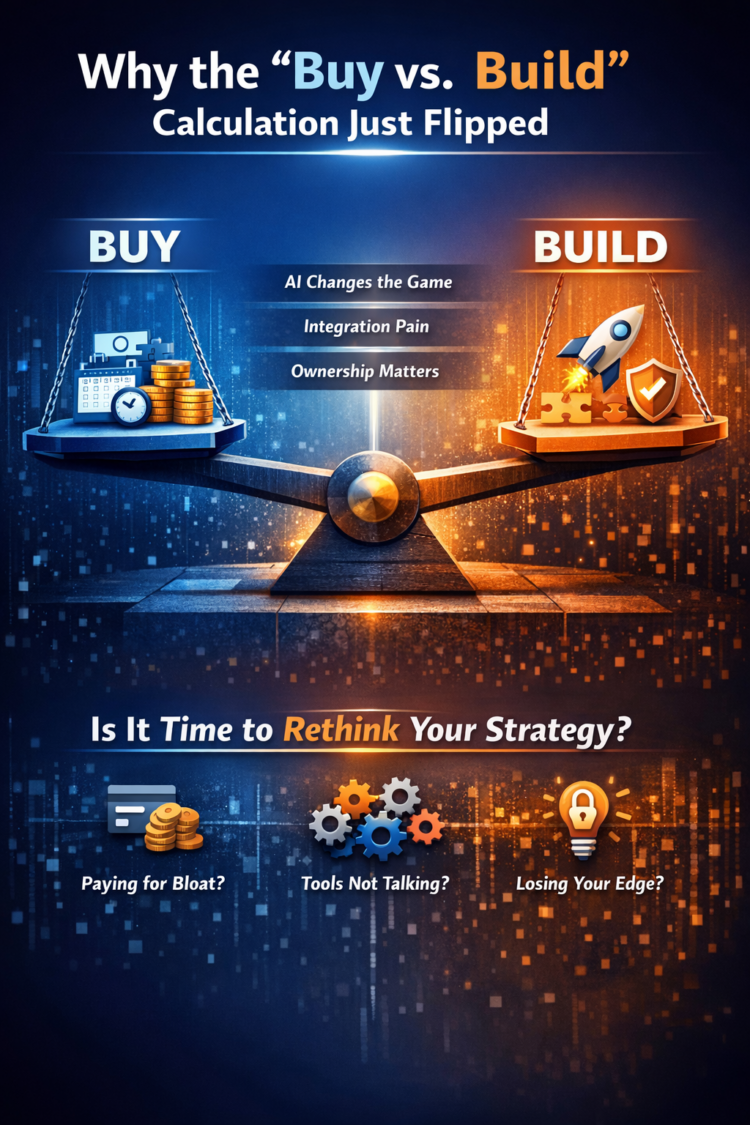
At Appoly, we have always built bespoke software. It is simply what we do. But for the past decade, we watched the wider market get swept up in a different mantra: “Don’t build what you can buy.”
The advice to businesses was absolute. Focus on your core product and outsource everything else to SaaS. For a long time, that logic held up. Building software was viewed as slow, expensive, and risky. Why spend six months developing an internal tool when you could sign up for something off the shelf in an afternoon?
But in the last eighteen months, we have watched that calculation change. The maths that used to favour buying does not work anymore.
We are seeing a major shift. Clients in healthcare, logistics, and financial services, businesses that previously would never have considered custom software, are now commissioning it.
The market is finally circling back to what we have known for years. Here is why.
The biggest barrier to building custom software used to be cost. Why spend £60,000 on a six-month development project when a £15,000 annual subscription gets you something that works today?
But that calculation is changing, and fast.
AI-assisted development has compressed timelines dramatically. Projects that would have taken months now take weeks. And that shifts the breakeven point in a way most businesses haven’t caught up with yet.
Here’s a real example. A client came to us paying £18,000 a year for a SaaS platform. They were using about 15% of its features. The rest was bloat, functionality they were paying for but would never need.
We built them a bespoke replacement for £20,000. It took six weeks, does exactly what they need, and nothing they don’t. By the end of year two, they’ll be £16,000 better off, and that gap only widens from there.
The old maths said subscribe. The new maths says build.
This is the hidden killer of the SaaS stack. Five “best in class” tools that do not talk to each other is not a solution. It is a headache with a monthly invoice.
I have lost count of the businesses I have spoken to that are running operations through a fragile web of Zapier automations, CSV exports, and manual data entry.
They bought the best tools, but the seams between them are where the real work happens, work often done by expensive humans manually moving data.
Custom software does not have seams. It is built around your actual workflow, not a generic approximation of it.
Off the shelf software is designed for the average use case. By definition, it is mediocre for everyone.
If your operations are your competitive advantage, if how you do things is why customers choose you, then forcing that process into a generic tool is actively harmful.
You are flattening your differentiation to fit someone else’s template.
I spoke to a logistics company recently that spent two years trying to make a well known route optimisation tool work for their specific constraints.
The result: two years of workarounds and being told “that’s not how the system works”.
The fix: they finally commissioned something custom. It took three months and solved problems the off the shelf tool could not even acknowledge existed.
The old criticism of custom software was maintenance: “You build it, you own the bugs.”
That is true. But consider the alternative: vendor dependency.
When you rely on a vendor’s roadmap, you are at their mercy.
Custom software does not have a roadmap you cannot control. It does not pivot. It does what you need it to do, for as long as you need it to do it.
We’re not suggesting anyone should build their own email client or accounting system. That would be daft.
But the line between “should build” and “should buy” has moved, and most businesses have not noticed yet.
The conditions have changed. AI lowered the cost of building, and integration complexity raised the cost of buying.
The questions worth asking:
We have always specialised in bespoke because we believed it was the superior long term strategy. Now, it seems the economics finally agree.