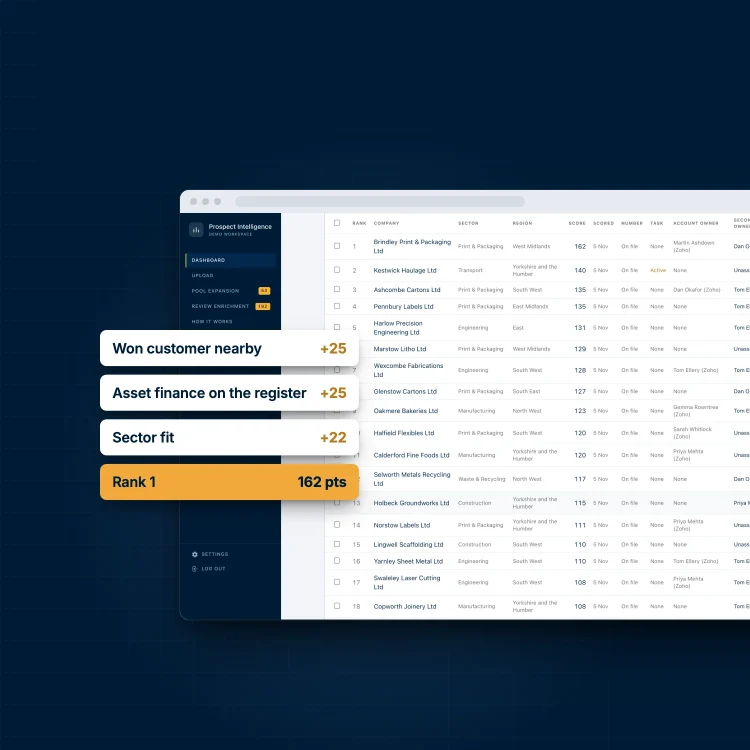
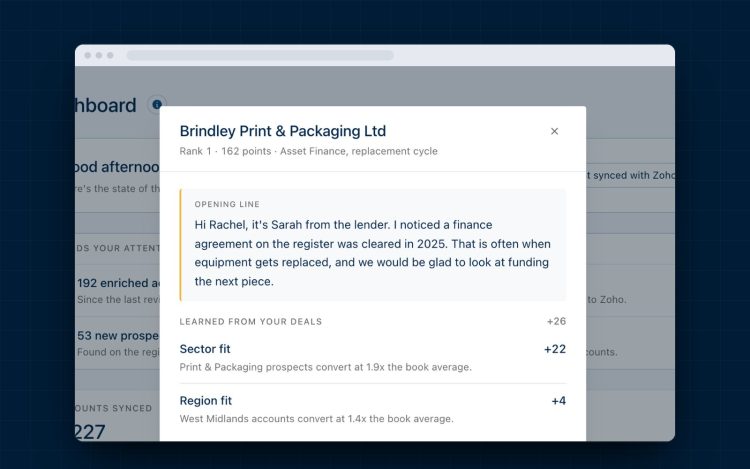
We started with a proof of concept on the client’s own data, which became a short analysis for their leadership. We matched thousands of paid-out finance agreements back to the CRM to see which kinds of company had gone from prospect to customer. Across the book, about 2.5% of accounts had.
The 90-day rule
Read straight from the CRM, companies under three years old seemed to convert at 5.7 times the book average. Many of those records had been created on the day the deal was signed, so they had never really been prospects. Once a conversion only counted if the account existed 90 days before the first deal, the figure fell to 2.0 times. Company age is still in the model, at the lower figure.
Which sectors convert
Print and packaging companies converted at 2.5 times the book average. Construction was the largest group in the book and one of the weakest, so working through the list in the order it arrived would put most calls in the wrong place.
Signals we tested and dropped
We tested eleven other candidate signals and dropped them, each with a recorded reason. Use of government-backed lending schemes looked promising, but customers and non-customers used them at almost the same rate (47.1% against 47.5%). A distance signal mostly reflected where the team had already been calling.
The model that remains has 18 signals. Three are measured from the client’s deals: sector, company age and region. Fifteen are flat awards, such as an equipment finance charge on the register or a won customer in the same postcode district. The weights are judgement calls, so they sit in settings where the team can see and change them. Uploading a new deals export re-measures the book, and any figure that moves by more than 25% is held for someone to review before it goes live.